

What is OT remote access?
In a plant, mine, terminal, pipeline, or energy facility, it is not always possible for every specialist to be physically on-site whenever an incident occurs.
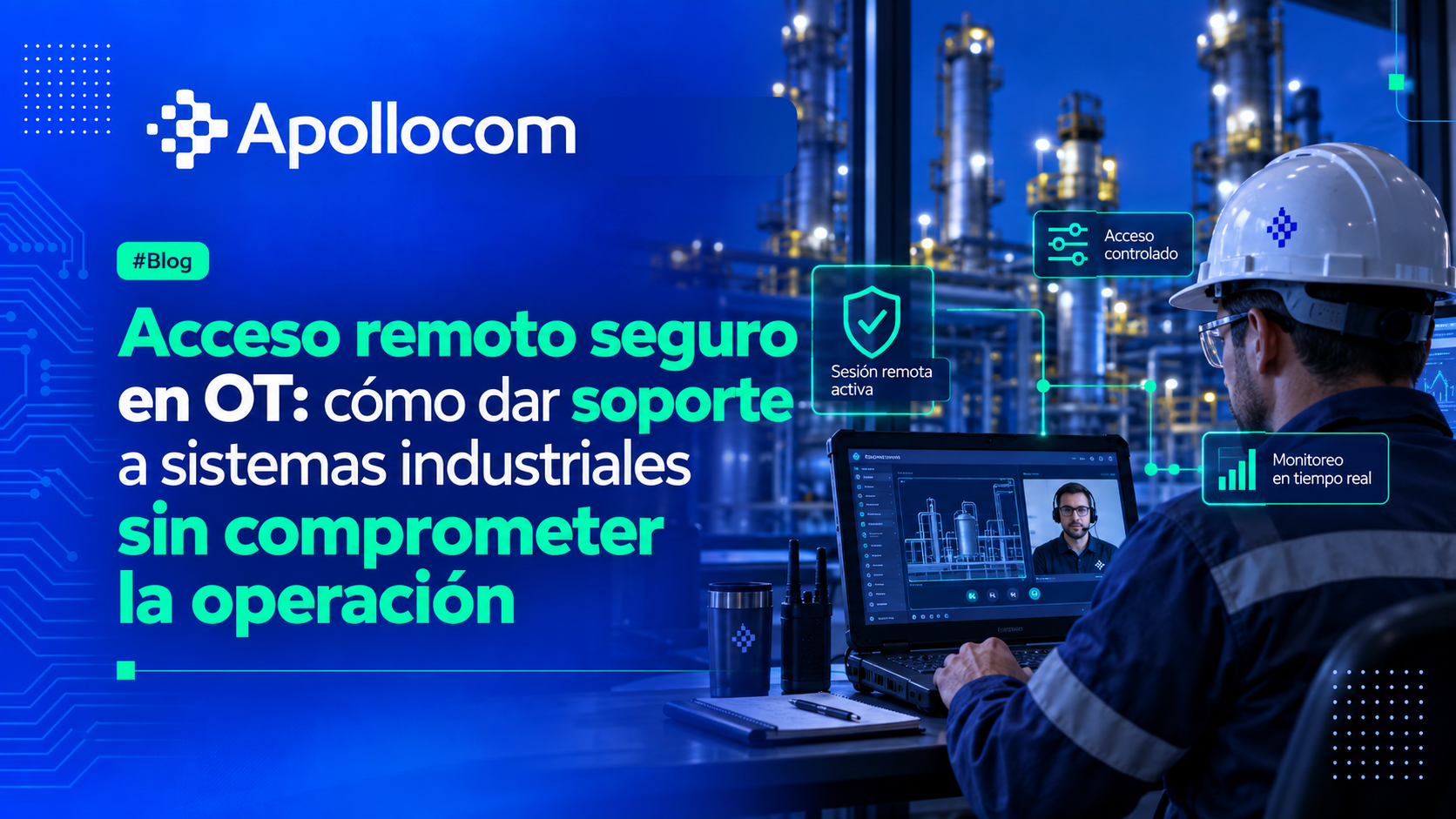
Remote access allows authorized personnel, vendors, or technical specialists to connect to specific systems from another location to diagnose issues, provide support, monitor assets, or perform maintenance tasks.
The benefit is clear: less downtime and faster response times.
The challenge is doing so without creating an unnecessary entry point into systems that control physical processes.
NIST defines operational technology (OT) as programmable systems and devices that interact with the physical environment, including industrial control systems, transportation, building automation, and water infrastructure, among others. Protecting them requires considering specific reliability, performance, and security requirements that are not always the same as those of traditional IT.
Why is remote access a challenge for OT cybersecurity?
On a corporate network, a remote user primarily accesses information or applications.
In OT, access can bring them closer to systems that monitor or control physical equipment, processes, and assets.
Furthermore, many industrial operations rely on specialized third parties. Manufacturers, integrators, maintenance personnel, or vendors may require temporary access to PLCs, SCADA, servers, or engineering workstations.
CISA notes that an industrial remote access strategy must specifically address the connections between operational assets, vendors, operators, and other entities that need to consult critical systems or information.
The problem is not remote access itself. The problem arises when an organization cannot clearly answer:
Who is logging in? To which system? For how long? With what privileges? What did they do during the session?
1. Know which assets can receive remote connections
Before securing access, you must understand the environment. An organization needs to identify which assets exist, which allow external connections, their level of criticality, and who is responsible for each one.
An up-to-date inventory helps detect legacy access points that may no longer be necessary, equipment connected without oversight, or systems where a vendor still holds permanent credentials.
Apollocom includes asset inventory, assessment, and classification within its cybersecurity capabilities.
2. Avoid direct and indiscriminate access
Remote access should follow a controlled path. Connecting an external device directly to a critical asset can reduce the ability to monitor who is entering and what they are doing.
A more secure architecture seeks to create controlled access points, separate networks, and limit connections only to the necessary systems. Segmentation helps ensure that authorized access to one zone does not automatically become access to the entire OT network.
3. Apply the principle of least privilege
Not everyone needs the same permissions. A vendor who needs to check diagnostic information may not need to modify settings. A technician performing maintenance on a specific piece of equipment should not necessarily have access to other systems in the plant.
Applying least privilege means granting only the permissions necessary to perform a specific task. This reduces exposure and helps contain errors or misuse.
4. Avoid permanent access when it is not necessary
A common mistake is keeping vendor accounts active "just in case." The problem is that a credential that remains available for months also remains a potential entry point.
When operations allow, it is best to use temporary access, authorized for a specific window and disabled once the task is complete. This way, the company retains the benefits of remote support without leaving doors open indefinitely.
5. Authenticate users correctly
A password alone may not be enough to protect sensitive access. Strong authentication and proper identity management help verify that the person trying to connect is actually the authorized individual.
It is also important to avoid shared accounts. If multiple people use the same credential, it becomes difficult to identify who made a change or when it occurred.
6. Log and monitor sessions
Traceability is key. A company should be able to reconstruct who connected, to which resource, when the session started, and what relevant actions were taken.
This not only helps in the event of a security incident, but also improves support management and allows for the investigation of unexpected changes.
Apollocom includes monitoring, access management, anomaly detection, and incident response within its OT cybersecurity approach.
7. Consider operational continuity
Securing a remote connection does not mean adding controls indiscriminately. In OT, the solution must respect the needs of the operation.
A security measure that interferes with a critical process or prevents a specialist from responding to an emergency can create a different kind of problem.
That is why NIST insists on addressing OT security by simultaneously considering performance, reliability, and physical safety. The strategy must find a balance between protection and availability.
OT remote access: a strategy, not a tool
There is no single product that can make any connection secure on its own.
A comprehensive strategy combines:
- Asset inventory.
- Segmentation.
- Identity and privilege management.
- Authentication.
- Temporary access.
- Monitoring.
- Activity logging.
- Procedures for vendors.
- Incident response.
Technology must be implemented based on a clear policy.
Frequently asked questions about secure OT remote access
What is OT remote access?
It is a connection from an external location to resources within an operational technology network for the purpose of support, supervision, diagnostics, or maintenance.
Should remote access be eliminated from an industrial network?
Not necessarily. It can improve efficiency and reduce response times. The goal is to control the connection and limit it according to risk and operational needs.
Can external vendors access OT?
They may require it for certain tasks, but it is advisable to establish permissions, authentication, access times, and traceability.
Where should you start?
To know which assets accept remote connections and who currently has permission to use them.
Conclusion
Remote access can be a highly valuable tool for maintaining industrial operations. It allows for faster system support, connecting specialists, and resolving issues without always relying on physical presence. However, that efficiency must be accompanied by control.
Knowing who is logging in, what they can do, how long they remain connected, and what happened during the session helps turn remote access into an operational capability rather than an unnecessary exposure.
At Apollocom, we integrate cybersecurity solutions for OT environments with a focus on both protection and operational continuity. If you would like to review how vendors and specialists are currently accessing your critical systems, we can help you identify the areas that should be strengthened.
.png)


%202.png)


